



Emiratisation Is Now a Financial & Compliance Obligation
From 2025 onwards, Emiratisation is no longer a policy recommendation — it is a mandatory compliance requirement enforced by the UAE authorities.
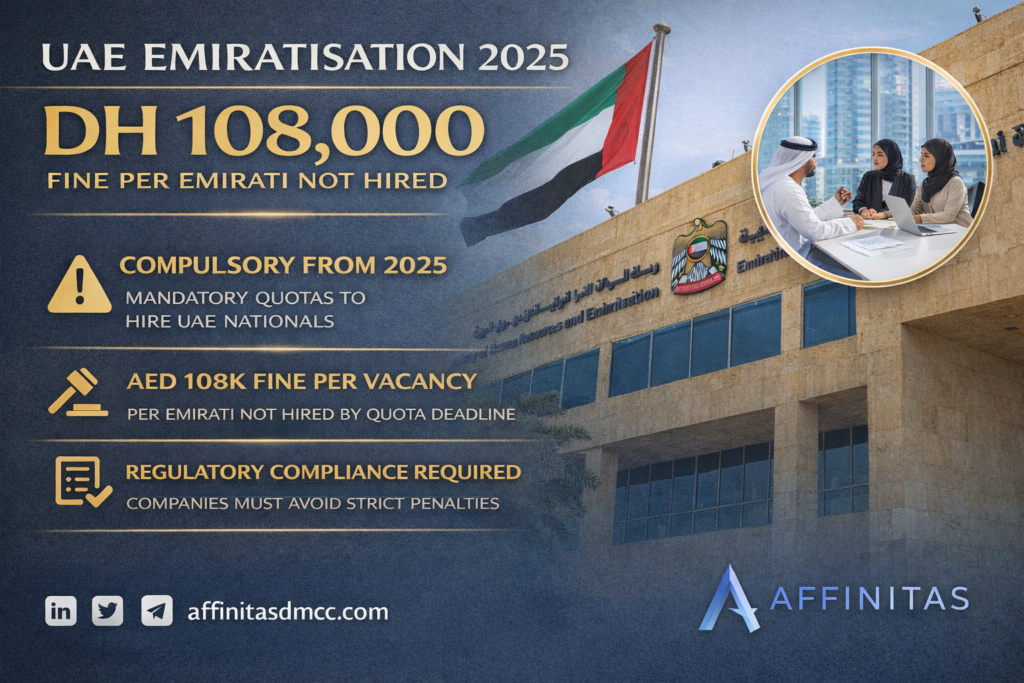
Private sector companies that fail to meet Emiratisation quotas face fines of AED 108,000 per missing Emirati employee per year, imposed by the Ministry of Human Resources and Emiratisation (MOHRE).
For many businesses, Emiratisation now represents a higher fixed financial risk than UAE Corporate Tax, VAT, or ESR penalties.
Affinitas FZCO advises UAE businesses on Emiratisation compliance, workforce structuring, and regulatory risk mitigation.
What Is Emiratisation?
Emiratisation is a UAE national strategy aimed at increasing the employment of UAE nationals (Emiratis) in the private sector.
The program is implemented and monitored by:
- Ministry of Human Resources and Emiratisation (MOHRE)
- UAE Government
It applies primarily to companies registered with MOHRE and meeting employee-count thresholds.
Emiratisation Requirements for 2025
According to official MOHRE regulations, companies must annually increase the number of Emirati employees in line with prescribed quotas.
Emiratisation Compliance Overview
| Requirement | Details |
|---|---|
| Applies to | Private sector companies |
| Employee threshold | 50+ employees |
| Annual quota increase | Mandatory |
| Penalty | AED 108,000 per missing Emirati |
| Enforcement authority | MOHRE |
Emiratisation Penalties Explained (2025)
Financial Penalty Structure
| Non-Compliance Scenario | Fine |
|---|---|
| 1 Emirati missing | AED 108,000 |
| 2 Emiratis missing | AED 216,000 |
| 5 Emiratis missing | AED 540,000 |
| Repeated violations | Escalating penalties |
| Fake Emiratisation | Severe fines + blacklisting |
⚠️ Important:
Fines apply annually and are not tax-deductible.
Who Must Comply With Emiratisation?
Companies Subject to Emiratisation
| Business Type | Emiratisation Applies? |
|---|---|
| Mainland LLC | ✅ Yes |
| Branch of foreign company | ✅ Yes |
| Professional license | ✅ Yes |
| Free Zone company (MOHRE-registered) | ✅ Case-by-case |
| Offshore company | ❌ No employees |
⚠️ Common mistake:
Many Free Zone companies assume exemption, but MOHRE registration overrides Free Zone status.
Affinitas FZCO performs Emiratisation eligibility audits to confirm exposure.
Emiratisation vs Other UAE Compliance Obligations
Comparative Compliance Risk Table
| Compliance Area | Financial Exposure | Frequency |
|---|---|---|
| Emiratisation | Fixed AED fines | Annual |
| Corporate Tax | 9% of profits | Annual |
| VAT | 5% | Quarterly |
| ESR | License risk | Annual |
| AML | Severe penalties | Ongoing |
👉 Emiratisation is one of the most predictable penalties — and therefore the easiest to plan for.
Common Emiratisation Mistakes That Trigger Fines
- Hiring Emiratis into non-genuine roles
- Underpaying below approved salary bands
- Incorrect job titles or classifications
- Failure to register Emiratis properly with MOHRE
- Ignoring annual quota increases
- Assuming Free Zone exemption
MOHRE actively audits:
- Payroll records
- Bank payments
- Visa data
- Insurance registrations
How Affinitas FZCO Supports Emiratisation Compliance
Affinitas FZCO provides end-to-end Emiratisation advisory, including:
- Emiratisation applicability assessment
- Quota calculation & future forecasting
- Emirati role structuring
- MOHRE registration & reporting
- Ongoing compliance monitoring
We integrate labour law, corporate structuring, and tax strategy into a single compliance framework.
Strategic Emiratisation: Cost vs Risk Comparison
| Approach | Outcome |
|---|---|
| Ignore quotas | Guaranteed fines |
| Last-minute hiring | High cost, low retention |
| Fake compliance | Severe penalties |
| Strategic planning | Lower cost, compliant |
Frequently Asked Questions (FAQ)
Is Emiratisation mandatory in Free Zones?
Some Free Zones are exempt, but companies registered with MOHRE are not automatically exempt. Individual assessment is required.
Can fines be avoided retroactively?
No. Fines apply once non-compliance is recorded.
Can Emiratisation be outsourced?
No. Emiratis must be real employees with genuine roles.
Will quotas increase after 2025?
Yes. The UAE government has confirmed gradual annual increases.
Sources
- Ministry of Human Resources and Emiratisation (MOHRE):
https://www.mohre.gov.ae - UAE Government Portal – Emiratisation:
https://u.ae/en/information-and-services/jobs/emiratisation - UAE Labour Laws & Cabinet Decisions:
https://www.mohre.gov.ae/en/laws-and-regulations.aspx