


By Affinitas FZCO — Corporate Structuring, Tax & Investment Advisory
For more than a decade, the Netherlands was one of Europe’s most attractive jurisdictions for founders, family offices, and international entrepreneurs.
Between 2024 and 2027, the Dutch government has introduced a sequence of tax reforms that fundamentally alter the country’s appeal for high-net-worth individuals and family investment structures. The result is not a gradual adjustment — but a rapid, strategic exit of family offices toward more stable jurisdictions.
At Affinitas FZCO, we are already advising multiple European families on relocation, holding restructures, and alternative jurisdictions, including the UAE.
What Changed in the Netherlands (2024–2027)
The Dutch tax overhaul did not arrive as a single law. It unfolded in layers, each removing a cornerstone of the Netherlands’ former attractiveness.
Key Measures Triggering the Exodus
| Measure | Status | Impact |
|---|---|---|
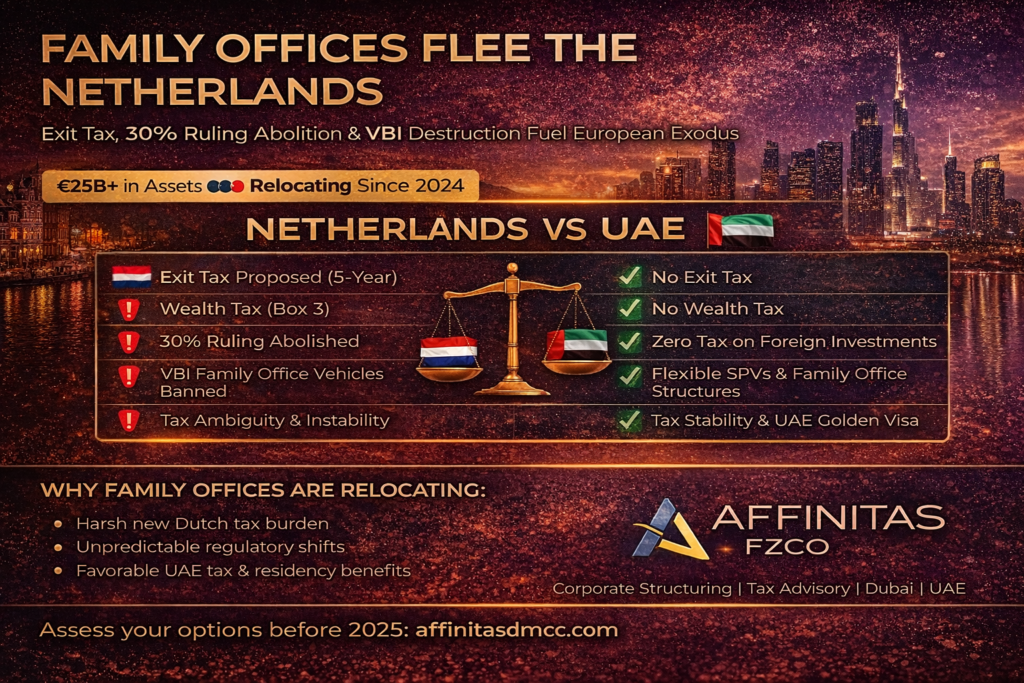
| 5-year exit tax on emigrants | Proposed / expected 2025 | Continued taxation after leaving |
| Abolition of 30% ruling (partial non-resident) | Effective 2025 | Global wealth now fully taxable |
| VBI regime eliminated | Effective 2025 | Family investment vehicles dismantled |
| Box 3 wealth tax | Ongoing | 36% tax on fictitious returns |
| 30% ruling cap | Since 2024 | €246,000 salary ceiling |
| Further reduction of 30% ruling | From 2027 | Drops to 27% |
Source:
Brand Finance, Dutch Ministry of Finance
🔗 https://www.government.nl
🔗 https://www.pwc.nl
🔗 https://taxsummaries.pwc.com/netherlands
The Exit Tax: “Blocking the Door”
One of the most alarming developments for entrepreneurs and family offices is the proposed five-year exit tax.
Under this framework, individuals who leave the Netherlands would remain subject to Dutch taxation on income and capital gains for up to five years after emigration.
“This is not an anti-avoidance rule. It is a direct deterrent to mobility.”
— European private client tax partner, cited by Affinitas FZCO
For founders planning liquidity events or generational succession, this locks capital inside the jurisdiction, creating unacceptable planning risk.
The Collapse of the 30% Ruling
The famous 30% expat ruling was once the Netherlands’ flagship incentive.
It is now effectively dismantled.
Timeline of the 30% Ruling Decline
| Year | Change |
|---|---|
| 2024 | €246,000 salary cap introduced |
| 2025 | Partial non-resident status abolished |
| 2027 | Tax-free allowance reduced to 27% |
Result:
Expats are now fully exposed to Box 2 and Box 3 taxation, including investment income and deemed wealth returns.
The End of the VBI Regime
The abolition of the Vrijgestelde Beleggingsinstelling (VBI) regime represents a direct hit to family-owned investment structures.
Previously, VBIs allowed:
- 0% corporate tax
- Efficient estate planning
- Segregated family capital
From 2025 onward:
- Only regulated funds (UCITS / AIFs) qualify
- Private family vehicles are excluded
- Legacy structures must restructure or relocate
For many families, relocation is simply cleaner.
Box 3: Tax on Income You Didn’t Earn
The Dutch Box 3 wealth tax remains one of the most controversial elements:
- 36% tax rate
- Applied to fictitious returns, not actual profits
- Supreme Court rulings allow rebuttal — but burden of proof lies with the taxpayer
This creates constant litigation risk and administrative burden for family offices.
Where Are Dutch Family Offices Going?
Based on Affinitas FZCO advisory mandates, we see four dominant destinations:
| Jurisdiction | Why It Attracts Capital |
|---|---|
| Portugal | Residency programmes, lifestyle, restructuring routes |
| Luxembourg | SPF & fund vehicles, treaty access |
| Ireland | Common law, post-Brexit positioning |
| United Arab Emirates | No wealth tax, stable regulation, global hub |
Why the UAE Is Winning Family Office Relocations
The UAE has positioned itself as the anti-thesis of unpredictable European tax policy.
Key advantages include:
- No personal income tax
- No wealth tax
- Corporate tax at 9%, aligned with OECD standards
- Extensive double tax treaty network
- Mature holding and SPV frameworks
- Clear economic substance rules
Expert View: This Is Not a Temporary Cycle
“What we are seeing is not tax optimisation — it is jurisdictional risk management.
Families are no longer asking how much tax they pay, but whether rules will still exist in five years.”
— Affinitas FZCO, Private Clients Advisory Team
Netherlands vs UAE: Strategic Comparison
| Factor | Netherlands | UAE |
|---|---|---|
| Exit tax | Yes (proposed) | No |
| Wealth tax | Yes | No |
| Tax stability | Declining | High |
| Family office vehicles | Restricted | Flexible |
| Capital mobility | Limited | High |
What Families Should Do Before 2025
If you currently operate from the Netherlands, timing matters.
Key steps include:
- Reviewing exposure to exit taxation
- Stress-testing Box 3 outcomes
- Assessing holding vs SPV migration
- Planning substance and governance early
- Avoiding rushed, reactive exits
How Affinitas FZCO Supports Family Offices
Affinitas FZCO advises European and international families on:
- ✅ Mainland & Free Zone company formation
- ✅ Corporate tax & compliance advisory
- ✅ Accounting & audit services
- ✅ Bank account opening support
If your Amsterdam-based structure is reassessing its future, early planning preserves options.