



The United Arab Emirates and Russia have officially signed and enacted a new Double Taxation Treaty (DTT), now published by the Ministry of Finance and fully in force.
This is not a theoretical framework anymore —
these rules are now applicable in real business scenarios.
While the treaty broadly aligns with the OECD Model Tax Convention (MTC), it introduces specific provisions that significantly affect UAE-based entities, FZCO structures, consultants, and remote workers operating with Russian counterparties.
For businesses operating across both jurisdictions, the implication is clear:
Your tax exposure, compliance obligations, and structuring strategy must be reassessed immediately.
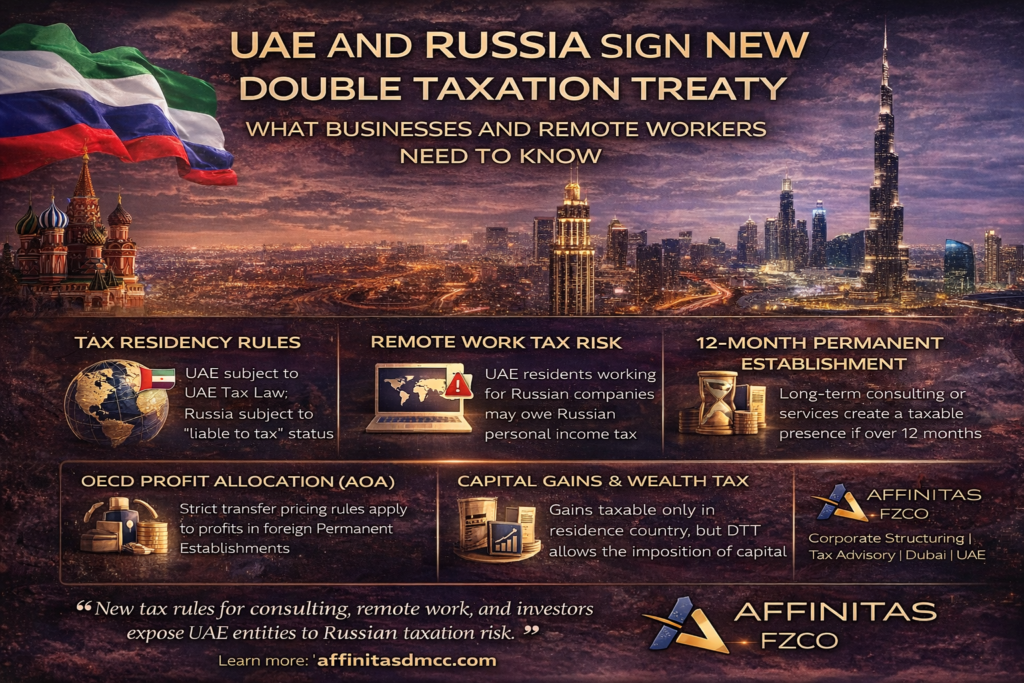
1. Tax Residency Rules (Article 4): The “Gatekeeper” Clause
The treaty establishes different criteria for determining tax residency — a critical factor that defines where taxation rights apply.
| Feature | UAE | Russian Federation |
|---|---|---|
| Residency Basis | UAE Tax Law provisions | “Liable to tax” principle |
| Key Focus | Legal residency + substance | Tax obligation within Russia |
| Risk | Misaligned residency status | Dual taxation exposure |
👉 Strategic Insight:
Many businesses incorrectly assume UAE residency automatically protects them from foreign tax — under this treaty, that assumption is no longer valid.
Official reference:
https://mof.gov.ae
https://tax.gov.ae
2. Remote Work Is Taxable
One of the most critical updates:
👉 A UAE resident working remotely for a Russian company
➡️ may be subject to Russian personal income tax
This directly impacts:
- remote employees
- consultants
- freelancers
- digital entrepreneurs
| Scenario | Risk Level |
|---|---|
| UAE resident working for Russian employer | High |
| Remote consulting services | High |
| Cross-border payroll without structuring | Very High |
Reality:
Remote work does NOT eliminate tax liability — it redistributes it.
3. The 12-Month Service Permanent Establishment (PE)
The treaty introduces a “service PE” rule:
A Permanent Establishment is triggered if:
- services are provided in a country
- for more than 12 months
| Activity | PE Risk |
|---|---|
| Long-term consulting | High |
| Advisory retainers | High |
| Technical services | High |
Once triggered:
- the company becomes taxable in Russia
- profit allocation rules apply
- compliance obligations increase significantly
4. OECD AOA: Profit Allocation Rules Now Apply
The treaty formally adopts the OECD Authorized Approach (AOA).
This means:
- profits must be allocated based on actual functions and risks
- transfer pricing documentation becomes mandatory
| Requirement | Impact |
|---|---|
| Transfer pricing reports | Increased compliance cost |
| Functional analysis | Required for PE allocation |
| Audit exposure | Higher |
Translation:
More structure = less risk
No structure = audit exposure
Reference:
https://www.oecd.org/tax/treaties/model-tax-convention/
5. Capital Gains: Major Opportunity for Investors
The treaty confirms:
👉 Gains from disposal of assets (excluding real estate)
➡️ taxable only in the country of residence
| Asset Type | Tax Treatment |
|---|---|
| Shares | Residence country |
| Business exits | Residence country |
| Movable assets | Residence country |
| Real estate | Source country |
👉 Strategic Advantage:
With correct structuring, UAE-based investors can optimize capital gains exposure.
6. Capital (Wealth) Tax: Now Explicitly Allowed
The DTT allows capital taxation rights:
👉 Governments may tax:
- net wealth
- capital holdings
This impacts:
- high-net-worth individuals
- family offices
- asset-heavy corporate structures
Strategic Implications for UAE Businesses
This treaty changes the operating reality for:
- FZCO entities
- DMCC companies
- consulting firms
- cross-border investors
- remote-first businesses
Immediate Risk Areas
| Area | Risk |
|---|---|
| Remote employees | Foreign tax liability |
| Consulting contracts | PE creation |
| Weak structures | Double taxation |
| No transfer pricing | Audit exposure |
Action Plan: What You Must Do Now
1. Review Contracts
Check consulting agreements exceeding 12 months
2. Audit Payroll Structures
Assess tax exposure for remote employees
3. Re-evaluate Tax Residency
Ensure compliance with UAE substance rules
4. Optimize Asset Holding
Leverage capital gains rules properly
5. Align with UAE Corporate Tax
👉 Register and comply here:
https://affinitasdmcc.com/corporate-tax-registration-in-dubai-and-abu-dhabi/
Structuring Is the Only Real Protection
With the DTT now active, structuring is no longer optional.
Using proper frameworks such as Holding or SPV structures is critical to:
- manage tax exposure
- separate risks
- optimize investments
👉 Learn more:
https://affinitasdmcc.com/holding-vs-spv/
Expert Insight
“The UAE–Russia DTT introduces clarity, but also removes the illusion of ‘zero-tax simplicity.’ Businesses must now actively manage cross-border tax exposure with proper structuring and compliance.”
— Affinitas FZCO Advisory Team
Common Mistakes
Let’s be direct:
- ❌ “I live in UAE, so I don’t pay tax anywhere” → wrong
- ❌ “Remote work is tax-free” → wrong
- ❌ “I don’t need structure” → expensive mistake
👉 This treaty exposes all three.
Who Is Most Affected
- Russian entrepreneurs relocating to UAE
- UAE residents working with Russian companies
- consultants and agencies
- digital nomads
- investors with cross-border assets
The UAE–Russia Double Taxation Treaty entering into force in 2026 is a major structural shift in international taxation.
It introduces:
- new compliance requirements
- real tax exposure for remote work
- stricter rules on consulting and PE
- opportunities for structured capital gains
Affinitas FZCO provides:
- ✅ Mainland & Free Zone company formation
- ✅ Corporate tax & compliance advisory
- ✅ Accounting & audit services
- ✅ Bank account opening support
📞 Call: +971 (0) 4 576 2903
📩 Email: inquiries@affinitasdmcc.com