



By Affinitas Advisory | affinitasdmcc.com | Fortune Tower, JLT, Dubai
Published: April 2026 | Reading time: ~10 min | Book a Free Advisory Call
In April 2026, the UAE confirmed what seasoned investors and business leaders have long understood: this is not a country that builds incrementally. It builds at scale, at speed, and with a level of strategic coherence that most economies never achieve.
A wave of infrastructure projects launched across every emirate — spanning energy, water, roads, real estate, economic zones and cultural infrastructure — signals not just continued government ambition, but a direct and measurable expansion of commercial opportunity for businesses operating in or entering the UAE.
| "Infrastructure investment at this scale is not just a signal of economic confidence — it is a direct invitation to business. Every billion-dirham project creates a chain of commercial opportunity for those with the right structure in place." — Affinitas Advisory Team |
1. The Scale of UAE Infrastructure Investment in 2026
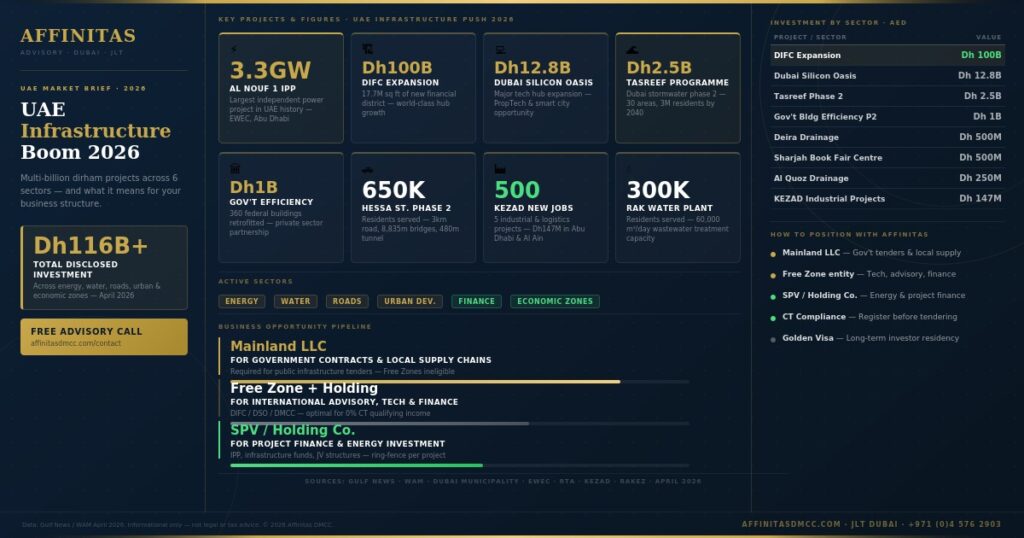
According to a report by Emirates News Agency (WAM) the UAE is executing a multi-billion dirham infrastructure programme across six key sectors simultaneously. This is not a cluster of isolated projects — it is a coordinated national delivery programme.
The headline figures alone illustrate the scale:
- Dh 100 billion — DIFC expansion (17.7 million square feet of new financial district floor area)
- Dh 12.8 billion — Dubai Silicon Oasis expansion
- Dh 2.5 billion — Dubai Tasreef Stormwater Programme Phase 2 (serving 3 million residents by 2040)
- Dh 1 billion — Federal Government Building Energy Efficiency Programme Phase 2 (360 buildings)
- Dh 500 million — Deira Stormwater Drainage Project
- Dh 500 million — Sharjah International Book Fair Exhibition Centre
- Dh 250 million — Al Quoz Creative Zone sewerage and drainage upgrade
- Dh 147 million — KEZAD industrial and logistics projects (500 new jobs)
And these represent only the disclosed figures. The Al Nouf 1 Independent Power Producer at 3.3 gigawatts — the largest IPP in the UAE's history — has not yet received a publicly disclosed contract value.
Source: Emirates News Agency (WAM) — UAE Infrastructure Updates 2026
2. Sector-by-Sector Breakdown: Where the Opportunities Are
Energy & Power
The 3.3-gigawatt Al Nouf 1 IPP represents a landmark moment for the UAE's energy sector. Developed by Emirates Water and Electricity Company (EWEC), the project is housed in the new Al Nouf complex — a purpose-built strategic energy site in Abu Dhabi incorporating advanced generation and low-carbon reverse osmosis desalination. Multiple competitive bids have already been received.
The Ministry of Energy and Infrastructure has also launched a Dh 1 billion programme to retrofit 360 government buildings for energy efficiency, following a Dh 120 million Phase 1 pilot across 60 facilities starting with Abdullah bin Omran Hospital in Ras Al Khaimah. This programme is being delivered in partnership with the private sector — a direct procurement opportunity.
Water, Wastewater & Drainage
Ras Al Khaimah has signed a long-term wastewater treatment agreement with a consortium of Etihad Water and Electricity, TAQA Water Solutions and Saur International Water Services. The 60,000 cubic metre per day plant will serve approximately 300,000 residents.
Dubai is executing two major drainage programmes simultaneously: the Dh 2.5 billion Tasreef Phase 2 (covering 30 areas across 430 million square metres) and the Dh 500 million Deira project (13 areas, 4,700 hectares, 60 kilometres of networks). In Sharjah, Kalba's water supply capacity has been expanded from 6 million to 9 million gallons per day.
Roads & Transport
Dubai's Roads and Transport Authority (RTA) has installed 726 modern bus shelters, upgraded marine transport facilities and developed three heavy vehicle rest areas for 490 trucks. The Hessa Street Phase 2 contract has been awarded — a 3-kilometre stretch with three major intersections, 8,835 metres of bridges and a 480-metre tunnel, serving an estimated 650,000 residents across 10 development areas.
Umm Al Qaiwain completed 30.74 kilometres of internal roads. Ajman inaugurated the Al Tallah Road development including an 800-metre bridge on Sheikh Mohammed bin Zayed Road and a 1,100-metre bridge on Sheikh Zayed Road.
Urban Development & Real Estate
The Dh 100 billion DIFC expansion is among the most significant real estate announcements in the region's history — adding 17.7 million square feet to what is already the Middle East's leading international financial centre. Combined with the Dh 12.8 billion Dubai Silicon Oasis expansion and the launch of the Liwan Oasis eco-leisure project, Dubai is executing a coordinated urban densification and diversification strategy.
Economic Zones & Industrial
Khalifa Economic Zones Abu Dhabi (KEZAD) secured five industrial and logistics projects in Abu Dhabi and Al Ain worth Dh 147 million, creating 500 jobs. RAKEZ marked the groundbreaking of a new 5,839 square metre storage facility. Both zones are actively tendering and attracting new industrial occupants.
Summary: Major UAE Infrastructure Projects 2026 at a Glance
| Sector | Project | Value (AED) | Impact |
| Energy & Water | EWEC Al Nouf 1 IPP (3.3 GW) | Multi-billion (TBC) | Largest IPP in UAE history |
| Energy & Water | Gov't Building Efficiency Programme Phase 2 | Dh 1 billion | 360 federal buildings upgraded |
| Water & Waste | RAK Wastewater Treatment Plant (60,000 m³/day) | Undisclosed | 300,000 residents served |
| Drainage | Dubai Tasreef Stormwater Programme Phase 2 | Dh 2.5 billion | 3 million residents by 2040 |
| Drainage | Deira Stormwater Drainage Project | Dh 500 million | 13 areas, 4,700 hectares |
| Urban Dev. | Dubai Silicon Oasis Expansion | Dh 12.8 billion | Major tech hub expansion |
| Finance | DIFC Expansion (17.7M sq ft) | Dh 100 billion | World-class financial district |
| Roads | Hessa Street Phase 2 (3 km, 3 intersections) | Undisclosed | 650,000 residents benefited |
| Culture | Sharjah Book Fair Exhibition Centre | Dh 500 million | SIBf 2027 ready |
| Economic Zones | KEZAD Industrial & Logistics Projects | Dh 147 million | 500 new jobs created |
3. What This Means for Businesses Looking to Enter or Expand in the UAE
Infrastructure spend of this magnitude does not just benefit the primary contractors. It creates a dense web of second and third-tier commercial opportunity across supply chains, professional services, technology, logistics and finance. The question is not whether there is opportunity — there clearly is. The question is whether your business is structured to access it.
| "Many businesses arrive in the UAE with genuine commercial intent but the wrong structure. A Mainland licence is required to tender for government contracts. A Free Zone entity cannot bid directly. Getting this wrong costs time, money and opportunity." — Affinitas Advisory Team |
Here is how we map the opportunity by sector:
| Infrastructure Sector | Business Opportunity | Recommended Structure | Jurisdiction |
| Energy & Green Tech | IPP / renewable energy investment | SPV or Holding Co. | Abu Dhabi / ADGM |
| Construction & Real Estate | Contractor, developer, supplier | Mainland LLC | Dubai / UAE-wide |
| Water & Environmental | Wastewater, desalination tech | Free Zone or JV | RAK / Sharjah |
| Logistics & Industrial | Warehousing, supply chain | KEZAD / RAKEZ licence | Abu Dhabi / RAK |
| Financial Services | Advisory, fund management | DIFC or ADGM entity | Dubai / Abu Dhabi |
| PropTech / Urban Dev. | Smart city, tech solutions | Dubai Silicon Oasis | Dubai |
Note: Structure recommendations are indicative. Optimal setup depends on activity type, ownership, revenue model and tax position. Affinitas provides bespoke advisory tailored to your specific circumstances.
4. Free Zone vs Mainland: The Critical Choice for Infrastructure-Adjacent Businesses
The single most common mistake businesses make when entering the UAE in the context of infrastructure or government-driven opportunity is choosing a Free Zone entity when their commercial model requires Mainland access.
This matters because:
- UAE government contracts — including most infrastructure procurement — require the supplier to hold a valid Mainland trade licence.
- Free Zone companies cannot invoice UAE-based clients (outside their Free Zone) without triggering corporate tax implications under the new CT regime.
- The 9% Corporate Tax introduced in June 2023 applies to Mainland entities but also to Free Zone entities that fail to meet Qualifying Free Zone Person (QFZP) criteria.
| Factor | Free Zone | Mainland LLC |
| Best for | International suppliers, tech, advisory | Local contracts, construction, government tenders |
| Corporate Tax | 0% on Qualifying Income (QFZP rules) | 9% on profits > AED 375,000 |
| Market Access | International & Free Zone clients | Full UAE market incl. government |
| Govt. Contracts | Not eligible directly | Eligible — essential for infrastructure work |
| Setup Speed | 3–7 business days | 2–4 weeks |
| Affinitas Recommendation | Tech & advisory arms, holding structures | Primary operating entity for UAE-based projects |
*QFZP 0% rate applies only to Qualifying Income. Strict conditions apply including substance requirements, nature of income and absence of a Permanent Establishment on Mainland.
For businesses targeting the infrastructure opportunity specifically, Affinitas typically recommends a dual-entity structure: a Mainland LLC as the primary operating entity (eligible for government tenders and local market access), supported by a Free Zone holding or advisory company where appropriate.
Holding Companies vs SPVs in the UAE — Affinitas Guide
Corporate Tax Registration in Dubai and Abu Dhabi — Affinitas
Frequently Asked Questions
Can a foreign company bid directly on UAE government infrastructure contracts?
Generally no. Most UAE government tenders require a locally registered Mainland entity. Foreign companies typically need to establish a UAE Mainland LLC (or a branch of a foreign company in some cases) to be eligible. Affinitas manages end-to-end business setup for clients seeking to access government procurement.
How long does it take to set up a UAE Mainland company?
A standard Mainland LLC can be incorporated within 2–4 weeks, depending on the activity type, emirate and processing times. Affinitas handles the full process including initial approvals, MOA drafting, DED/economic department submission and bank account opening support.
Is a Free Zone company ever suitable for infrastructure-related work?
Yes — for international advisory, engineering consultancy, technology supply and professional services delivered to non-UAE-resident clients, a Free Zone entity can be optimal. The key distinction is whether you are serving the UAE domestic market (requires Mainland) or providing services from the UAE to international clients (Free Zone can work well).
What is the Golden Visa and is it relevant to infrastructure investors?
The UAE Golden Visa provides 10-year renewable residency to investors, entrepreneurs and skilled professionals. For infrastructure investors committing significant capital or establishing substantive operations in the UAE, the Golden Visa provides long-term residency security — an important consideration for those making multi-year capital commitments.
How does the 9% corporate tax affect infrastructure project profitability?
At 9%, UAE corporate tax remains internationally competitive. Infrastructure projects generating profits above AED 375,000 per annum will be subject to CT. Proper structuring — including the use of project SPVs, correct treatment of capex and depreciation, and compliance with transfer pricing rules — can optimise the effective tax rate. Affinitas provides CT advisory as part of all business setup engagements.
Final Insight: The Window Is Open — But Structure Determines Who Benefits
The UAE's 2026 infrastructure programme represents one of the most concentrated periods of economic opportunity this region has seen. From the Dh 100 billion DIFC expansion to multi-billion dirham energy, water and transport projects stretching from Abu Dhabi to Ras Al Khaimah, the commercial landscape is being reshaped in real time.
If you are:
- Looking to enter the UAE market to access infrastructure-related opportunities
- Operating a business that could supply to or support UAE government projects
- Seeking to upgrade your existing structure to access government procurement
- Wanting to ensure your UAE entity is Corporate Tax compliant before tendering
...the right first step is a conversation with Affinitas.
| Book Your Free 30-Minute Advisory Call+971 (0) 4 576 2903 | inquiries@affinitasdmcc.com affinitasdmcc.com/contact |