


A Practical Guide for International Investors, Family Offices & Multinationals
When structuring investments in the UAE, one question comes up repeatedly:
Should I use a Holding company or a Special Purpose Vehicle (SPV)?
Although these structures are often mentioned together, they serve very different strategic, legal, and tax purposes. Choosing the wrong one can lead to inefficiencies, compliance risks, or limited exit flexibility. Choosing the right one can significantly enhance asset protection, tax efficiency, and long-term scalability.
This guide explains the real differences between Holdings and SPVs in the UAE, using practical case studies and current regulatory context.
Holding Companies in the UAE
A Holding company is an entity established primarily to own and manage equity stakes in one or more subsidiaries. In international structures, the Holding often sits at the top of the group, acting as the strategic and financial control centre.
Holdings can be:
- Pure Holdings – owning participations only
- Mixed Holdings – owning participations while also providing services (management, IP, treasury, etc.)
Core Functions of a Holding Company
A UAE Holding structure is typically used to:
- Centralise ownership of international subsidiaries
- Optimise group-level tax efficiency
- Separate operating risk from valuable assets
- Facilitate mergers, acquisitions, exits, and restructurings
- Support long-term expansion and capital raising
A Holding is not transactional. It is designed as a permanent, scalable structure that grows with the business group.
Case Study: UAE Holding for International Investors
Scenario
A group of European investors establishes a UAE Holding company to manage investments across the Middle East and Asia.
Structure
- UAE Free Zone Holding company
- 100% ownership of operating subsidiaries in Saudi Arabia, India, and Singapore
- Centralised management and strategic decision-making in the UAE
Key Advantages
- Access to the UAE’s extensive double tax treaty network
- No withholding tax on dividends under UAE law
- Potential exemption on capital gains from qualifying shareholdings
- Centralised governance in a politically stable jurisdiction
- Substance established through UAE office, directors, and staff
- Future-ready platform for acquisitions and exits
Sources
Understanding Special Purpose Vehicles (SPVs)
A Special Purpose Vehicle (SPV) is a company created for one specific transaction or project. Unlike a Holding, an SPV is not designed to last indefinitely.
SPVs are commonly used to:
- Isolate financial or operational risk
- Hold a single asset or project
- Enable structured finance or non-recourse lending
- Simplify entry and exit mechanics
The defining feature of an SPV is its “bankruptcy-remote” nature: financial issues in the sponsor entity do not affect the SPV, and vice versa.
Case Study 1: SPV for UAE Real Estate Acquisition
Scenario
An international family office acquires a USD 120 million portfolio of commercial properties in Dubai.
Structure
- UAE SPV holding the properties directly
- Funding via shareholder loan
- Property management outsourced to licensed UAE operators
Why an SPV works
- Liability limited strictly to the SPV
- Asset protection for family office wealth
- Clean exit via share transfer instead of asset transfer
- Succession and estate planning flexibility
- Foreign ownership permitted without local sponsor
Relevant authority
Case Study 2: SPV for Renewable Energy Project Finance
Scenario
A consortium develops a 200 MW solar project in the UAE.
Structure
- Project SPV with equity and non-recourse debt
- 25-year Power Purchase Agreement (PPA)
- Revenue secured by a government-linked off-taker
Results
- Full isolation of project risk
- Bankable structure for international lenders
- Predictable cash flows
- Alignment with UAE Net Zero 2050 strategy
Authority sources
Holding vs SPV: Key Differences at a Glance
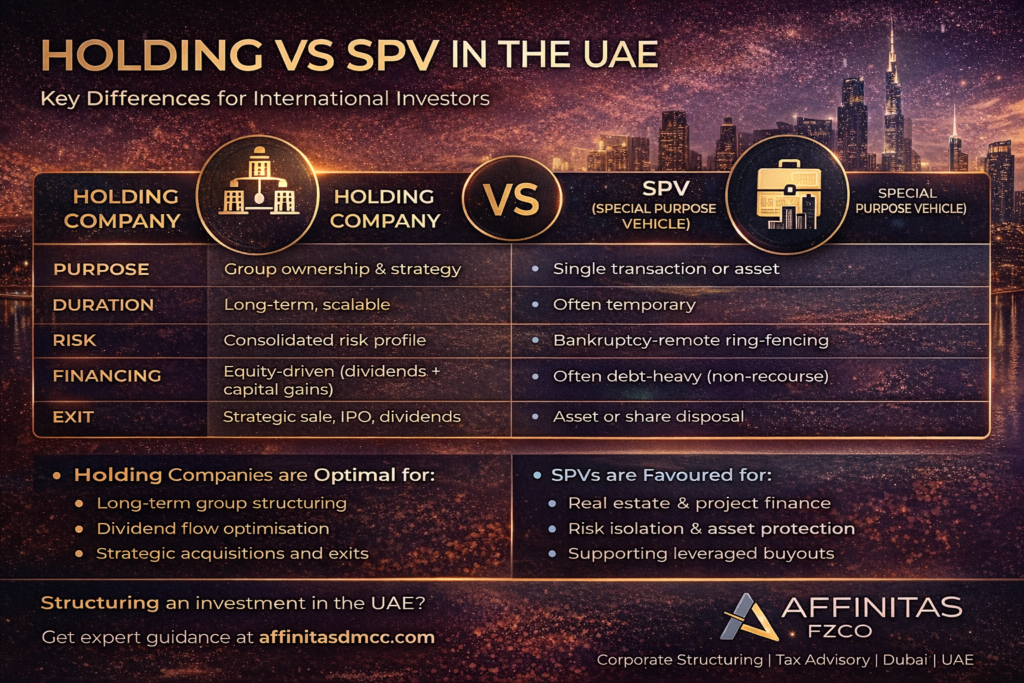
| Factor | Holding Company | SPV |
|---|---|---|
| Purpose | Group ownership & strategy | Single transaction or asset |
| Duration | Long-term | Often temporary |
| Scope | Multiple subsidiaries | Limited to one project |
| Risk Profile | Consolidated | Bankruptcy-remote |
| Financing | Equity-driven | Often debt-heavy |
| Exit | Strategic sale / IPO | Asset or share disposal |
Tax & Regulatory Considerations in the UAE
Under UAE Corporate Tax rules:
- Holdings may benefit from participation exemptions on dividends and capital gains, subject to qualifying conditions
- SPVs are structured for transaction-specific efficiency rather than long-term tax planning
Both structures require:
- Proper substance
- Accurate transfer pricing (where applicable)
- Ongoing compliance and reporting
Authority references
Expert Insight from Affinitas FZCO
“The most common mistake we see is investors using an SPV when they actually need a Holding — or building a Holding when a clean SPV would deliver better protection and exit flexibility. Structure must follow strategy, not the other way around.”
— Affinitas FZCO, Corporate Structuring Team
How Affinitas FZCO Advises Investors
Affinitas FZCO supports international investors with:
- Holding vs SPV structuring analysis
- Free Zone and Mainland jurisdiction selection
- Corporate tax and substance compliance
- Investment-grade structuring for banks and regulators
- Long-term restructuring and exit planning
Conclusion
Holdings and SPVs are not interchangeable.
- A Holding company is the backbone of a long-term international group
- An SPV is a precision tool for executing defined transactions
For investors entering or expanding in the UAE, the decision must be based on strategy, risk profile, tax position, and future plans.
With increasing regulatory scrutiny and substance requirements, professional structuring is no longer optional — it is a strategic necessity.
If you are planning to establish a Holding or SPV in the UAE, a tailored advisory approach can make the difference between a compliant structure and a costly restructuring later.