


By Affinitas FZCO — Corporate Structuring, Tax & Investment Advisory | Dubai, UAE
Last updated: 2026
Global wealth is on the move.
In 2026, high-net-worth individuals (HNWIs), ultra-high-net-worth individuals (UHNWIs), founders, and family offices are increasingly relocating from Europe, the UK, and parts of Asia to jurisdictions offering tax certainty, political stability, asset protection, and long-term regulatory clarity.
At the center of this migration shift stands the United Arab Emirates.
Dubai and Abu Dhabi have become primary destinations for global wealth — not merely because of tax advantages, but because of structural predictability and geopolitical neutrality.
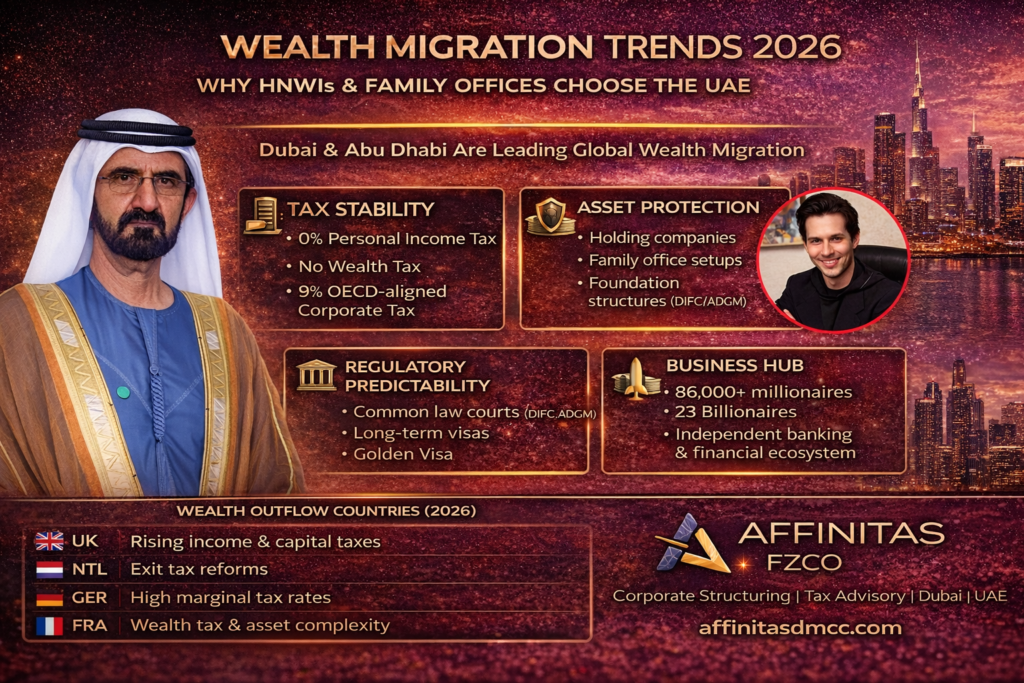
Global Wealth Migration Snapshot (2026)
According to leading private wealth intelligence sources:
- Dubai ranks among the top wealth-growing cities globally
- The UAE continues to record net positive millionaire inflows
- Europe and the UK are experiencing net wealth outflows
Key Sources:
- Henley & Partners Wealth Migration Report
https://www.henleyglobal.com - New World Wealth Research
- Khaleej Times
https://www.khaleejtimes.com - UAE Government Portal
https://u.ae
Why HNWIs Are Relocating in 2026
Wealth migration is rarely emotional — it is strategic.
The following drivers dominate 2026 relocation decisions:
1. Rising Exit Taxes & Wealth Taxation in Europe
Several European jurisdictions have introduced or expanded:
- Multi-year exit taxation on emigrants
- Box 3 wealth taxation (Netherlands)
- Higher capital gains taxation
- Increased dividend taxation
- Broader anti-avoidance measures
For many entrepreneurs and family offices, remaining exposed to long-term tax uncertainty has become a material financial risk.
2. Tax Stability in the UAE
By contrast, the UAE offers:
| Tax Category | UAE |
|---|---|
| Personal Income Tax | 0% |
| Wealth Tax | None |
| Capital Gains Tax | None (for most structures) |
| Withholding Tax | None |
| Corporate Tax | 9% |
The UAE Corporate Tax regime, introduced in alignment with OECD standards, provides clarity without aggressive wealth taxation.
🔗 Internal Guide:
UAE Corporate Tax Explained
3. Regulatory Predictability
High-net-worth individuals prioritize:
- Legal certainty
- Independent courts
- Capital mobility
- Predictable corporate law
Jurisdictions such as:
- DIFC (Dubai International Financial Centre)
- ADGM (Abu Dhabi Global Market)
- DMCC (Dubai Multi Commodities Centre)
offer internationally recognized legal frameworks based on English common law.
4. Asset Protection & Structuring Opportunities
Relocating wealth is not merely about residency — it is about structure.
Common structures used in the UAE:
- Holding companies
- SPVs (Special Purpose Vehicles)
- Foundations (DIFC / ADGM)
- Family offices
- Trust structures
🔗 Internal Resource:
Holding vs SPV in the UAE
5. Geopolitical Neutrality & Safety
The UAE is consistently ranked among the safest countries globally.
Key factors include:
- Political neutrality
- Strong diplomatic positioning
- Business-friendly visa frameworks
- Golden Visa residency options
For capital preservation, geopolitical stability matters as much as tax efficiency.
Top Countries Experiencing Wealth Outflows (2026)
| Country | Primary Driver of Outflow |
|---|---|
| UK | Rising income & capital taxes |
| Netherlands | Exit tax reforms & Box 3 wealth tax |
| Germany | High marginal tax rates |
| France | Wealth tax & regulatory complexity |
| China | Capital controls |
Why the UAE Is Winning Wealth Migration
| Factor | UAE | EU Average |
|---|---|---|
| Wealth Tax | No | Yes (many states) |
| Exit Tax | No | Increasingly common |
| Capital Mobility | High | Medium |
| Corporate Tax | 9% | 20–30% |
| Legal Stability | High | Variable |
The Family Office Effect
Dubai now hosts a growing ecosystem of:
- Private banks
- Multi-family offices
- Investment funds
- Venture capital networks
With over 86,000 millionaires and 23 billionaires, the capital ecosystem has reached critical mass.
This creates:
- Investment liquidity
- Deal flow access
- Private equity opportunities
- Structured asset diversification
Expert Perspective
“Wealth migration is rarely about chasing zero tax. It is about reducing structural risk. The UAE offers clarity, enforceable law, and capital mobility — that combination is rare.”
— Affinitas FZCO Private Wealth Advisory
Practical Considerations Before Relocating
Relocation requires careful planning across:
- Personal tax residency rules
- Corporate restructuring
- Double tax treaty review
- Exit tax exposure in origin country
- Substance requirements in UAE
- Transfer pricing implications
Frequently Asked Questions (FAQ)
1. Is the UAE a tax haven?
No. The UAE has introduced OECD-aligned corporate tax and transparency frameworks.
2. Does the UAE impose wealth tax?
No.
3. Can family offices relocate easily?
Yes, with proper structuring and compliance planning.
4. Is substance required in the UAE?
Yes, particularly for Free Zone qualifying income.
5. Can businesses redomicile to the UAE?
In certain cases yes; alternatively, restructuring through holding formation is common.
Strategic Relocation Checklist
Before relocating:
✔ Review exit tax exposure
✔ Evaluate holding structure
✔ Plan residency timeline
✔ Confirm corporate tax impact
✔ Align banking and compliance
✔ Structure asset protection
Conclusion
Wealth migration in 2026 reflects a global shift toward jurisdictions offering stability over experimentation.
The UAE has positioned itself not merely as a low-tax destination — but as a credible, transparent, and globally integrated financial hub.
For high-net-worth individuals, entrepreneurs, and family offices, the question is no longer “Why Dubai?”
It is increasingly:
“How long can we afford to wait?”