


UAE Labour Law Explained for Employees and Businesses in 2026
By Affinitas FZCO — Corporate Structuring, Tax & Regulatory Advisory | Dubai, UAE
Last updated: March 2026
Regional disruptions, flight cancellations, and temporary airspace restrictions occasionally leave expatriate employees stranded outside the United Arab Emirates. When this happens, an important legal question arises:
Can an employer legally stop paying an employee’s salary if the employee cannot return to the UAE due to circumstances beyond their control?
Under UAE Labour Law (Federal Decree-Law No. 33 of 2021), the answer depends on several factors, including the reason for travel, the employment contract, and whether the employee remains able to perform their duties remotely.
Understanding these legal boundaries is essential for both employees and employers operating within the UAE’s regulatory framework.
UAE Labour Law and Salary Obligations
The UAE labour framework aims to balance employee protection with employer operational needs.
While there is no single clause specifically addressing employees stranded abroad, the law provides broader principles governing salary payments, contractual obligations, and termination rights.
Key legislation includes:
- Federal Decree-Law No. 33 of 2021 on the Regulation of Labour Relations
- UAE Civil Code (Federal Law No. 5 of 1985)
- Ministry of Human Resources and Emiratisation (MOHRE) regulations
Sources:
https://www.mohre.gov.ae
https://u.ae/en/information-and-services/jobs
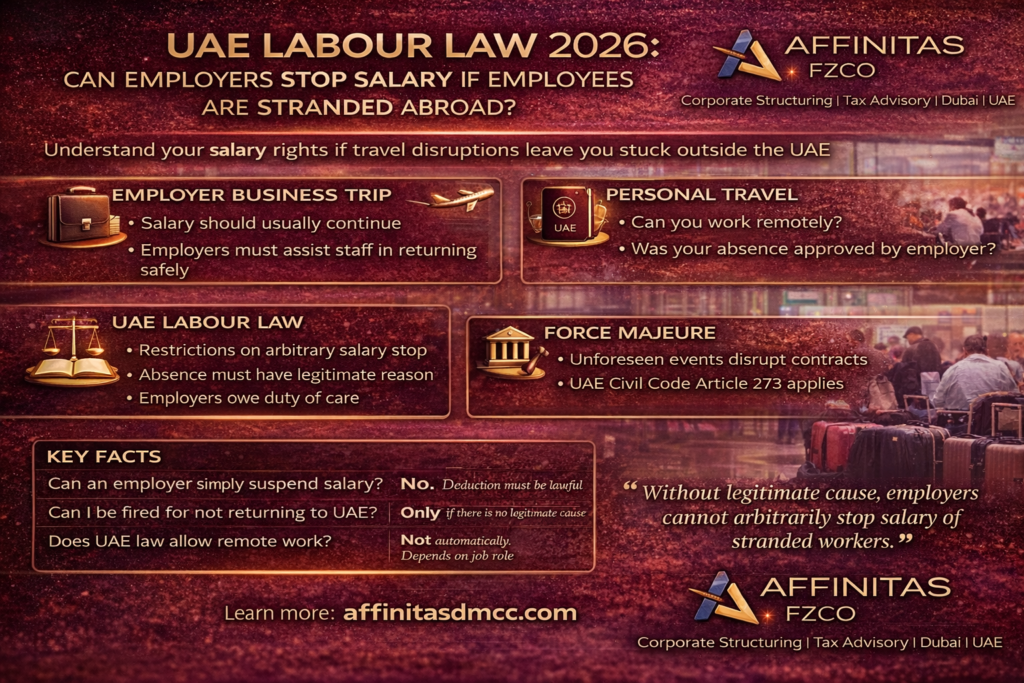
When Employers Must Continue Paying Salary
In many situations, the employer cannot simply stop salary payments.
The legal outcome largely depends on why the employee is outside the UAE.
Scenario 1: Employee Travelling on Employer Business
If the employee was travelling for work purposes and became stranded due to external circumstances (such as flight cancellations or geopolitical disruptions), the employer typically remains responsible.
| Employer Obligations | Explanation |
|---|---|
| Salary continuation | Employee remains available to work |
| Travel assistance | Employer should help arrange return |
| Accommodation support | Reasonable costs may apply |
In such cases, the employee is still ready and willing to perform their duties, meaning salary payments usually continue.
When Salary Disputes May Arise
If the employee was travelling for personal reasons, the situation becomes more complex.
Employers may question salary obligations where:
- The employee cannot perform duties remotely
- The absence was not approved
- The employment contract requires physical presence
However, UAE law does not allow employers to suspend salary arbitrarily.
Salary deductions must comply with:
- The employment contract
- UAE Labour Law provisions
- MOHRE regulations
Article 44 and Absence from Work
Article 44 of Federal Decree-Law No. 33 of 2021 allows termination in certain cases of prolonged absence.
However, termination is only permitted if the absence has no legitimate justification.
Examples of valid reasons may include:
- Airspace closures
- Flight cancellations
- Conflict or security concerns
- Government travel restrictions
Legal experts emphasize that being stranded due to circumstances beyond the employee’s control may constitute a legitimate reason.
Force Majeure and Contractual Adjustment
Another relevant legal principle comes from Article 273 of the UAE Civil Code, which addresses situations where contractual obligations become impossible due to unforeseen events.
Under this provision:
| Legal Principle | Explanation |
|---|---|
| Force majeure | Contracts may be suspended or modified |
| Impossibility of performance | Obligations may be adjusted |
| Temporary disruption | Employers and employees must negotiate solutions |
This principle often applies during major disruptions such as pandemics, conflicts, or global travel restrictions.
Official source:
https://u.ae/en/information-and-services/justice-safety-and-the-law/labour-law
Remote Work Considerations
Remote work can significantly influence salary obligations.
If an employee can continue working remotely, employers generally have stronger grounds to maintain salary payments.
However, remote work is not automatically guaranteed.
Factors that influence remote work eligibility include:
- Job role requirements
- Company policies
- Employment contract terms
- Operational needs of the employer
Lessons from the COVID-19 Pandemic
Previous disruptions provide useful precedent.
During the COVID-19 pandemic, the UAE government introduced temporary labour measures, including:
- Remote work frameworks
- Temporary salary adjustments
- Paid or unpaid leave agreements
- Visa extensions for stranded workers
These policies demonstrated that the UAE legal system recognizes extraordinary circumstances affecting employment relationships.
Employer Duty of Care
Employers also have a duty of care toward employees, particularly when travel occurs for work purposes.
In periods of disruption, responsible employers often assist employees by:
- Rebooking flights
- Covering accommodation costs
- Monitoring travel advisories
- Providing insurance support
Failure to consider employee safety may create legal risks for companies.
Legal Perspective
Legal professionals emphasize that most stranded worker situations are resolved through negotiation rather than litigation.
“Periods of geopolitical disruption often turn into workplace negotiations. Employers may attempt to adjust salary obligations, but unilateral suspension of salary can raise legal concerns.”
— Regional employment law expert
Implications for Businesses Operating in the UAE
Companies operating in the UAE must ensure that their employment contracts, HR policies, and compliance procedures align with UAE labour regulations.
Corporate compliance also extends beyond labour law to broader regulatory obligations.
Businesses must also ensure proper tax registration and regulatory compliance.
For guidance on corporate compliance requirements, see:
https://affinitasdmcc.com/corporate-tax-registration-in-dubai-and-abu-dhabi/
For companies structuring international operations, corporate vehicles may also be relevant:
https://affinitasdmcc.com/holding-vs-spv/
Key Takeaways for Employees and Employers
| Situation | Likely Outcome |
|---|---|
| Employee stranded on work trip | Salary typically continues |
| Employee stranded on personal trip | Depends on remote work ability |
| Employer stops salary unilaterally | May violate labour law |
| Absence due to flight disruption | Often considered legitimate reason |
Frequently Asked Questions
Can my employer legally stop paying my salary if I am stuck abroad?
Not automatically. Employers must follow UAE Labour Law and cannot suspend salary arbitrarily.
Can my employer terminate my contract because I cannot return to the UAE?
Termination for absence is only allowed where no legitimate reason exists.
Do employers have to help employees stranded abroad?
If the employee was travelling for work purposes, employers generally have a duty to assist.
Does UAE law automatically allow remote work?
No. Remote work depends on job role, company policy, and contractual terms.
Conclusion
Situations where employees are stranded outside the UAE highlight how employment law interacts with global events.
While UAE labour legislation does not contain a specific clause covering stranded workers, existing legal principles offer protection against arbitrary salary suspension or termination.
In most cases, the practical solution lies in cooperation and negotiation between employers and employees, guided by the legal framework provided under UAE law.
For businesses operating internationally, maintaining clear employment policies and regulatory compliance remains essential.
Affinitas FZCO advises companies on regulatory compliance, corporate structuring, and tax obligations for businesses operating in the UAE and across international markets.
Affinitas FZCO provides:
- ✅ Mainland & Free Zone company formation
- ✅ Corporate tax & compliance advisory
- ✅ Accounting & audit services
- ✅ Bank account opening support
📞 Call: +971 (0) 4 576 2903
📩 Email: inquiries@affinitasdmcc.com