


Dubai Holding and Microsoft have announced what they describe as the first deployment of enterprise-scale AI of its kind in the Middle East and Africa. It spans real estate, hospitality, retail, entertainment, and investment operations. For businesses and investors already operating in — or planning to enter — the UAE, this is not a headline about two large organisations. It is a signal about the direction of the entire market.
Dubai Holding operates across real estate, hospitality, retail, entertainment, investments, and community management. Its portfolio includes assets that define the physical and commercial character of Dubai. When an organisation of that scale commits to integrating AI into its core operational processes and decision-making frameworks, the downstream effect on suppliers, tenants, partners, and competitors in the same market is significant. AI readiness is quietly becoming a condition of commercial engagement in Dubai — not a differentiator, but a baseline expectation.
1. What Dubai Holding and Microsoft Actually Announced
The partnership was formalised on 18 May 2026 and announced jointly by Dubai Holding and Microsoft. According to the official press release published via Zawya, the collaboration establishes what both parties describe as the first deployment of enterprise-scale AI of its kind in the Middle East and Africa region.
The scope is deliberately broad. Under the agreement:
| Element | Detail |
|---|---|
| Sectors covered | Real estate, hospitality, retail, entertainment, investments, community management |
| Technology deployment | AI integration into core operational processes and decision-making frameworks across the Dubai Holding portfolio |
| Employee access | All staff across the group will access AI tools through a unified interface, applying AI capabilities within daily responsibilities |
| AI agents | Deployment of AI agents designed to automate routine tasks, streamline workflows and improve productivity |
| Enablement programme | Structured training including workshops and practical use-case development to ensure consistent adoption across the organisation |
| Strategic alignment | UAE National AI Strategy 2031 and the Dubai AI Roadmap |
| Broader AI portfolio | Complements Dubai Holding's existing joint venture Aither with Palantir Technologies |
The phrase "first deployment of its kind at enterprise scale in the region" is notable. It is not claiming to be the first use of AI in the UAE — it is claiming to be the first time an organisation of Dubai Holding's scale has embedded AI uniformly across its entire operational structure rather than in isolated departments or experimental pilots. That distinction matters because it represents a meaningful shift from AI as a technology project to AI as an operating model.
Technology is central to how we operate and create value across the organisation. Our collaboration with Microsoft reflects a deliberate step in embedding artificial intelligence into our core operations, in line with Dubai's broader digital transformation ambitions. By integrating AI into everyday workflows, we are strengthening performance and decision-making, while continuing to invest in our people to ensure they are equipped to operate effectively and drive long-term value creation.— Amit Kaushal, Group Chief Executive Officer, Dubai Holding
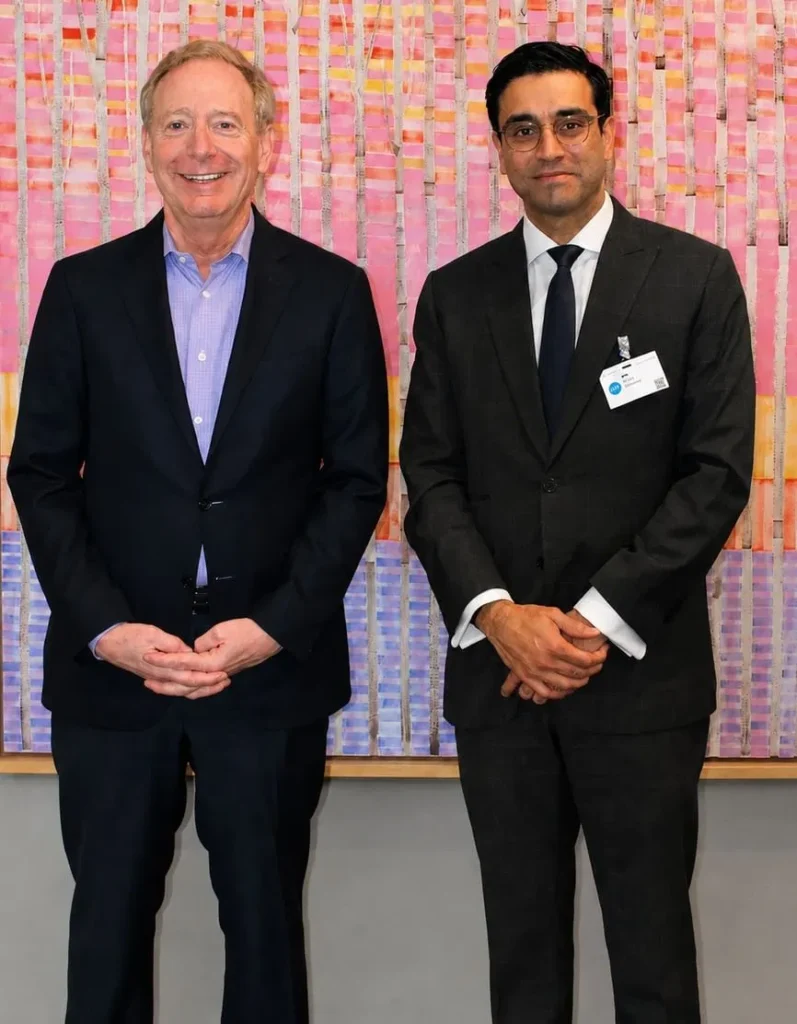
The next phase of artificial intelligence is defined by how organisations apply it at scale to drive productivity and long-term value. Our role is to support customers like Dubai Holding with the platforms and capabilities needed to integrate AI securely into their operations, while advancing responsible innovation that benefits employees, businesses and the broader economy.— Brad Smith, Vice Chair and President, Microsoft
2. Microsoft's $15.2 Billion UAE Commitment: The Infrastructure Behind the Partnership
The Dubai Holding partnership does not exist in isolation. It is the most visible recent expression of a much larger, multi-year commitment by Microsoft to the UAE — one that has been reshaping the country's technology infrastructure since 2023.
Microsoft has committed $15.2 billion to the UAE between 2023 and 2029 — the single largest technology infrastructure commitment in the UAE's history. The investment is structured across two phases and covers data centre infrastructure, AI compute capacity, talent development, and strategic partnerships.
2023–25
Phase 1 — $7.3 billion deployed
Includes a $1.5 billion equity stake in G42 (the UAE's sovereign AI company), $4.6 billion in capital expenses for AI and cloud data centres, and $1.2 billion in local operating costs. Also includes the opening of the Global Engineering Development Center and the AI for Good Lab in Abu Dhabi.
2026–29
Phase 2 — $7.9 billion planned
More than $5.5 billion in further AI and cloud infrastructure expansion, including the 200 megawatt data centre addition through G42's Khazna Data Centers coming online by end of 2026. An additional $2.4 billion in operating costs and talent development. Commitment to skill one million UAE residents by end of 2027.
May 2026
Dubai Holding partnership — enterprise-scale AI deployment
First MEA deployment of enterprise-scale AI across a major diversified conglomerate, built on Microsoft's Azure infrastructure operating from within the UAE, with full sovereign data residency.
Two aspects of this investment deserve particular attention for businesses operating in the UAE. First, Microsoft operates two Azure cloud regions in the UAE — Azure UAE North in Dubai and Azure UAE Central in Abu Dhabi — both certified by the Dubai Electronic Security Center (DESC). This means that AI services and data processing can operate from within UAE borders, meeting local data residency regulations without routing through European or US infrastructure.
Second, Microsoft's AI Diffusion Report places the UAE first globally in per-capita generative AI usage, with 59.4% of the population actively using generative AI tools — ahead of Singapore at 58.6%, and significantly ahead of every European economy. This is the operating environment that businesses choosing to establish in Dubai are entering.
3. The UAE National AI Strategy 2031 and the Dubai AI Roadmap: What They Mean in Practice
Both executive quotes from the partnership announcement reference national strategic frameworks by name. This is not incidental language — the UAE's AI strategy is a genuinely operational framework, not a policy document that sits in a government archive.
| Framework | Scope | Relevance to Businesses in Dubai |
|---|---|---|
| UAE National AI Strategy 2031 | Federal — covers all emirates | Sets targets for AI adoption across government and private sectors; drives public investment in AI infrastructure and talent; shapes regulatory approach to AI governance |
| Dubai AI Roadmap | Emirate-level — Dubai-specific | Operationalises the federal strategy within Dubai; covers smart city applications, AI-enabled government services, and private sector enablement programmes |
| UAE AI Specialist Visa (May 2026) | Federal — ICP / MOHRE | Dedicated visa category for AI professionals; signals active government effort to attract and retain AI talent within the UAE labour market |
| MOHRE 9-Tier Skill Classification | Federal — labour market | AI and technology roles increasingly classified at Levels 1–2 (highest tier), qualifying holders for extended grace periods and broader exemptions from work permit restrictions |
The practical consequence of these frameworks is that AI investment in the UAE receives active government support — not simply permissive regulation, but direct enablement through infrastructure, talent channels, and preferential visa structures. For international businesses assessing where to base their AI-adjacent operations, this combination of incentives, infrastructure, and strategic intent is materially different from what most other jurisdictions currently offer.
4. Dubai Holding's AI Architecture: What "Enterprise Scale" Actually Means
The phrase enterprise-scale AI is used frequently and often imprecisely. The Dubai Holding–Microsoft partnership provides a useful reference point for what it means in operational practice — and why it represents a genuine benchmark rather than a marketing claim.
Most organisations currently using AI in the UAE — and globally — do so in one of three ways: isolated departmental pilots (a single team using an AI tool), surface-level tooling (email drafting, presentation creation through consumer AI applications), or point solutions (AI applied to one specific process such as fraud detection or customer service routing). None of these constitute enterprise-scale deployment.
What distinguishes the Dubai Holding model:
🔗 Unified Interface Across All Business Units
All employees across the entire Dubai Holding portfolio — across real estate, hospitality, retail, and more — access AI through a single platform. This eliminates fragmentation and ensures consistent governance of AI usage across the organisation.
🤖 AI Agents for Operational Automation
AI agents are being deployed specifically to automate routine tasks and streamline workflows — not simply to assist human decision-making, but to replace manual steps in operational processes. This is a materially higher level of AI integration than copilot tooling.
🏛️ Governance and Security at Scale
The partnership explicitly addresses "governance, security and controls required to operate AI responsibly at scale." This is the element most organisations underinvest in — and the one that creates liability and compliance exposure when absent.
🎓 Structured Enablement, Not Just Technology
A formal training and workshop programme is embedded in the partnership — ensuring adoption is driven by capability development, not tool deployment alone. Technology without trained users produces limited operational value.
The shift from isolated AI experimentation to enterprise-wide deployment is the inflection point that separates organisations that benefit from AI from those that merely talk about it. Dubai Holding's partnership with Microsoft represents exactly this transition — and sets an expectation for how serious organisations in the UAE will operate from 2026 onwards.— Affinitas Advisory Team
5. The UAE's AI Position in Global Context
It is useful to situate this announcement within the broader competitive landscape for AI-first business destinations. The UAE is not simply a regional leader in AI adoption — it is a global outlier.
| Country | Generative AI Adoption Rate | Notable AI Infrastructure | Corporate Tax Rate |
|---|---|---|---|
| UAE | 59.4% — No. 1 globally | $15.2B Microsoft investment; G42 sovereign AI; 200MW Azure expansion; UAE AI Strategy 2031 | 9% (0% on qualifying Free Zone income) |
| Singapore | 58.6% — No. 2 globally | Strong government AI programme; Southeast Asia hub | 17% |
| United States | Below 50% | Global AI infrastructure leader; primarily private sector | 21% federal + state |
| United Kingdom | Below 50% | Emerging national AI strategy; London fintech ecosystem | 25% |
| Germany | Below 50% | Industrial AI applications; regulatory caution | ~30% combined |
Sources & External References
- Gulf News — Dubai Holding partners with Microsoft, 18 May 2026: gulfnews.com
- Zawya — Official Dubai Holding press release, 18 May 2026: zawya.com
- Economy Middle East — Dubai Holding Microsoft AI partnership: economymiddleeast.com
- Emirates247 — Dubai Holding embeds AI across MEA operations: emirates247.com
- Microsoft On the Issues — $15.2 billion UAE investment commitment: blogs.microsoft.com
- Gulf News — Microsoft ramps up $15.2B UAE investment: gulfnews.com
- Computer Weekly — Microsoft's $15.2B UAE investment in depth: computerweekly.com
- Microsoft AI Diffusion Report — UAE generative AI adoption rate (59.4%): microsoft.com
- UAE Government — National AI Strategy 2031: u.ae
- Affinitas FZCO — Free Zone Business Setup guide: affinitasdmcc.com