



By Affinitas FZCO — Corporate Structuring, Tax & Compliance Advisory
The UAE is entering a new phase of tax maturity in 2026. Following the introduction of Corporate Tax and expanded international reporting obligations, the Federal Tax Authority (FTA) is rolling out a series of procedural and enforcement updates that will materially affect how businesses operate, report, and defend their tax positions.
These changes are not cosmetic. They are designed to tighten compliance, align the UAE with OECD standards, and reduce ambiguity in enforcement. Businesses that prepare early will avoid penalties, audits, and cash-flow disruptions. Those that delay risk operational and financial exposure.
This guide explains the five most important UAE tax rule changes for 2026, what they mean in practice, and how businesses should prepare.
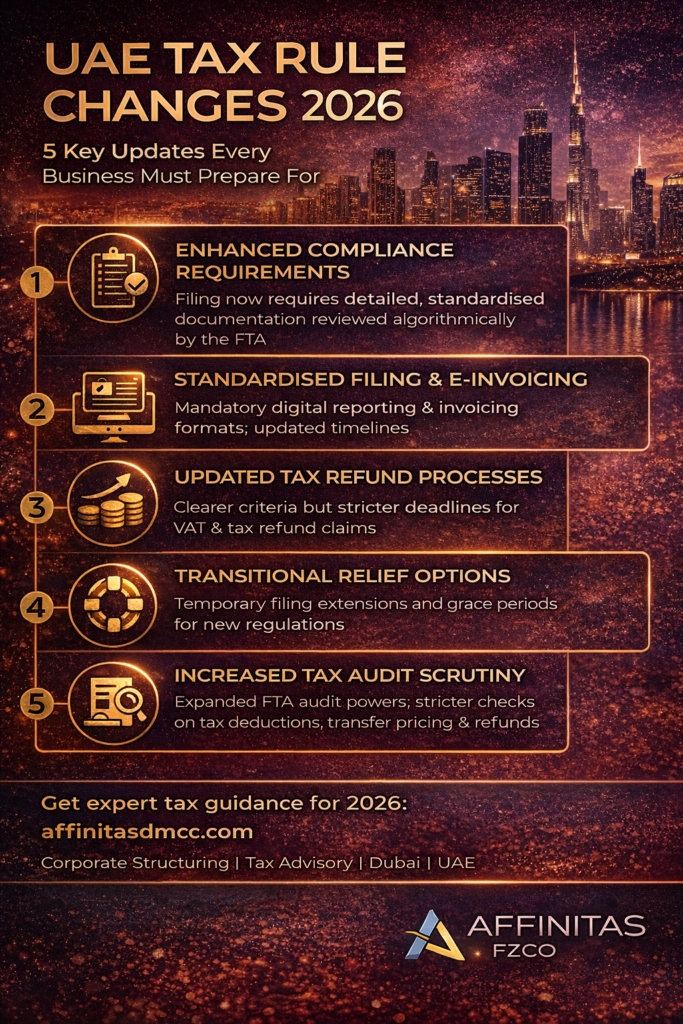
Snapshot: UAE Tax Changes 2026 at a Glance
| Area | What Changes in 2026 | Risk if Unprepared |
|---|---|---|
| Compliance & Record-Keeping | More detailed documentation standards | Penalties, audit adjustments |
| Tax Filing & Formats | Standardised digital filing & e-invoicing | Late filings, rejection |
| VAT & Tax Refunds | Clearer but stricter refund timelines | Lost refunds, cash-flow strain |
| Transitional Relief | Limited grace periods | Missed relief opportunities |
| Tax Audits | Expanded audit powers | Retroactive assessments |
1. Enhanced Compliance Requirements by the Federal Tax Authority
From 2026, the FTA will enforce stricter compliance standards across Corporate Tax and VAT filings. Documentation that was previously “acceptable in practice” will no longer pass scrutiny.
Businesses will be expected to:
- Maintain complete, auditable records of all financial transactions
- Use standardised reporting formats compatible with FTA systems
- Submit filings and supporting documents within precise statutory timelines
These measures are aimed at reducing manual errors and increasing transparency.
Affinitas FZCO Insight:
“The FTA is shifting from reactive enforcement to proactive risk detection. Businesses should assume that filings will be reviewed algorithmically before any human audit begins.”
🔗 Source:
Federal Tax Authority – Compliance Obligations
2. Changes in Tax Filing & Documentation Processes (Including E-Invoicing)
One of the most operationally impactful changes in 2026 is the move toward fully standardised electronic filing and invoicing.
Key developments include:
- Mandatory structured invoice formats
- Integration of accounting systems with FTA platforms
- Reduced tolerance for manual or unstructured submissions
This will require businesses to upgrade accounting software, internal workflows, and staff training.
🔗 Read more:
UAE E-Invoicing Rules 2026: Compliance, Timelines & Penalties
3. Updated UAE Tax Refund Procedures
The UAE has clarified refund mechanisms, but with tighter evidentiary standards.
To qualify for VAT or refundable Corporate Tax credits:
- Records must be complete, accurate, and consistent
- Supporting documents must meet formal validity standards
- Refund claims must be submitted within statutory deadlines
From 2026, delayed or poorly supported refund claims are far more likely to be rejected.
| Refund Area | Key 2026 Requirement |
|---|---|
| VAT Refunds | Five-year claim limitation |
| Corporate Tax Credits | Clear reconciliation trail |
| Supporting Evidence | Contract-level documentation |
🔗 Source:
FTA VAT Refund Guidelines
4. Transitional Relief Measures — Limited but Strategic
Recognising the scale of reform, the UAE has introduced transitional relief provisions for 2026. However, these are not automatic.
Possible relief measures include:
- Extended deadlines for legacy filings
- Temporary exemptions for newly introduced reporting formats
- Phased implementation for complex structures
Key risk: Transitional relief is time-bound. Businesses that do not actively track eligibility may lose access permanently.
🔗 Source:
UAE Tax Procedures Law Amendments
5. Increased Tax Audit Scrutiny in the UAE
With enhanced data visibility, tax audit frequency and depth are expected to increase significantly in 2026.
High-risk audit areas include:
- Intercompany transactions
- Transfer pricing documentation
- Deduction eligibility
- Refund claims
- Substance and economic rationale
| Audit Focus Area | Risk Level |
|---|---|
| Transfer Pricing | High |
| Related-Party Financing | High |
| Refund Claims | Medium-High |
| Filing Accuracy | Medium |
Affinitas FZCO Advisory:
“The cost of audit defence is always higher than the cost of prevention. Internal review cycles are now a necessity, not a luxury.”
How Businesses Should Prepare Now
Practical steps to take before 2026:
- Review existing tax policies and documentation
- Upgrade accounting and invoicing systems
- Train finance and compliance teams
- Conduct a pre-audit health check
- Engage experienced UAE tax advisors early
Why Acting Early Matters
Preparing now allows businesses to:
- Avoid penalties and enforcement actions
- Protect cash flow through timely refunds
- Improve tax planning accuracy
- Strengthen governance and investor credibility
The 2026 reforms mark the UAE’s transition from a tax-light jurisdiction to a globally respected, compliance-driven system.
FAQs – UAE Tax Rule Changes 2026
What is the new deadline for VAT refund claims?
Businesses have five years from the end of the relevant tax period to submit claims.
Is self-invoicing under reverse charge still required?
No. From 2026, supporting documentation replaces mandatory self-invoicing.
Can the FTA audit beyond normal limitation periods?
Yes, in cases involving suspected evasion or complex historical matters.
What transitional relief exists for expiring refund rights?
A one-year grace period applies for certain legacy claims.
How have audit powers changed?
The FTA can now conduct more flexible, risk-based audits, including unannounced inspections.
Conclusion
The UAE Tax Rule Changes 2026 represent a decisive shift toward clarity, enforcement, and international alignment. For businesses operating in the UAE, early preparation is the difference between strategic advantage and regulatory exposure.
Affinitas FZCO advises corporates, Free Zone entities, and international groups on tax structuring, compliance, audits, and regulatory strategy across the UAE.
If you need guidance for 2026, speak with our tax advisory team to ensure your structure is compliant, efficient, and future-proof.
Affinitas FZCO provides:
- ✅ Mainland & Free Zone company formation
- ✅ Corporate tax & compliance advisory
- ✅ Accounting & audit services
- ✅ Bank account opening support
📞 Call: +971 (0) 4 576 2903
📩 Email: inquiries@affinitasdmcc.com