



By Affinitas FZCO — Corporate Structuring, Tax & Regulatory Advisory
Last updated: 2026
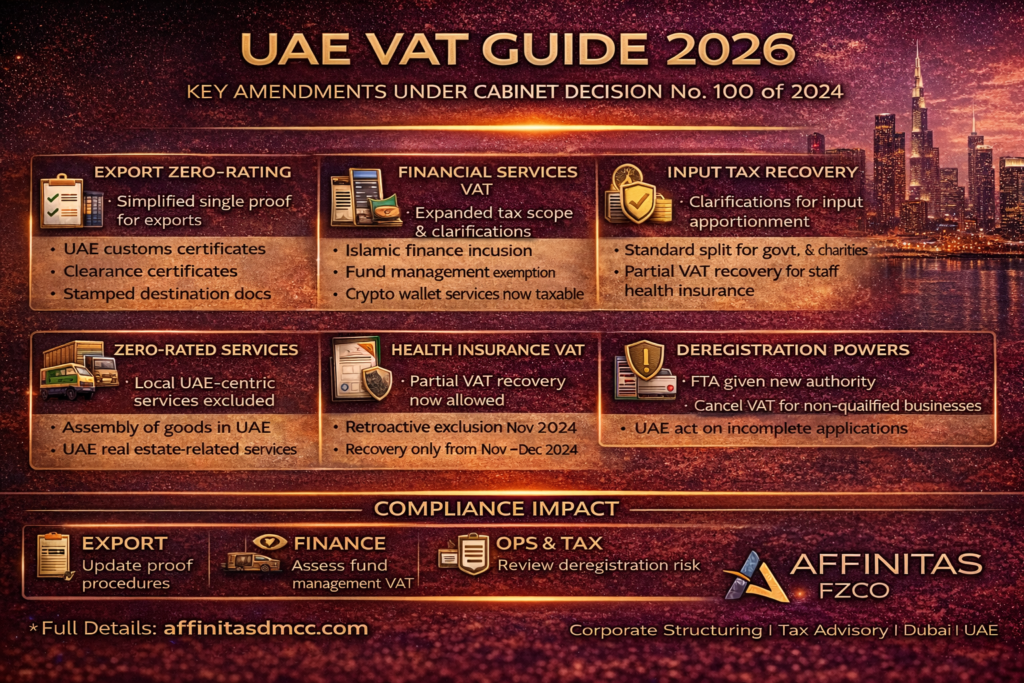
The UAE’s VAT framework continues to mature in line with global tax transparency standards. Cabinet Decision No. 100 of 2024 introduced significant amendments to the VAT Executive Regulation under Federal Decree-Law No. (8) of 2017 on VAT, with further clarification issued through FTA Public Clarification No. 40.
As of 2026, no additional Cabinet Decisions have altered these rules. However, compliance expectations have tightened — and enforcement has become more data-driven.
For international businesses, Free Zone companies, financial institutions, and family offices operating in the UAE, understanding these changes is no longer optional — it is a compliance imperative.
Legal References
- UAE Federal Tax Authority (FTA)
- Cabinet Decision No. 100 of 2024
- Federal Decree-Law No. 8 of 2017 (VAT Law)
- Public Clarification VATP040
Executive Summary: What Changed?
| Area | Key Amendment | Business Impact |
|---|---|---|
| Export Documentation | Simplified zero-rate proof | Lower administrative burden |
| Financial Services | Expanded definitions | Impact on Islamic finance & funds |
| Virtual Assets | Clarified VAT treatment | Crypto-related services taxable |
| Input Tax Apportionment | Clarifications for government & charities | Standard split applies |
| Health Insurance VAT | Partial recovery allowed | Restricted transitional period |
| Deregistration | FTA powers expanded | Increased enforcement risk |
| Profit Margin Scheme | Broader purchase price definition | Margin recalculation needed |
1. Zero-Rating of Exports – Reduced Burden of Proof
One of the most practical reforms concerns export documentation under Article 30 of the Executive Regulation.
From 15 November 2024, businesses exporting goods may retain any one of the following:
• Customs declarations + commercial evidence
• Shipping certificates + official evidence
• Suspension confirmation under GCC Common Customs Law
New Acceptable Evidence Includes:
- UAE customs export certificates
- Clearance certificates
- Certified documents from destination country authorities
Documents must be:
- In Arabic or English
- Or accompanied by certified translation
- Officially stamped or sealed
This significantly reduces the administrative burden.
Expert Insight — Affinitas FZCO:
“The reform recognises commercial reality. Exporters no longer need excessive duplication of evidence — but documentation discipline remains essential.”
2. Financial Services & Islamic Finance Clarifications
Article 42 expands VAT scope and clarifies treatment for:
Islamic Financial Arrangements
Transactions such as:
- Ijarah
- Murabaha
- Salam
must align with “relevant laws” governing VAT treatment.
Investment Fund Management
| Scenario | VAT Treatment |
|---|---|
| Licensed UAE Funds | Exempt |
| Unlicensed Funds | May require VAT registration |
Fund managers must reassess VAT exposure.
Virtual Assets
Charges for managing cryptocurrency wallets in the UAE are taxable.
Definition clarified:
“Virtual assets” include cryptocurrencies but exclude digital representation of local currency.
This aligns with broader UAE digital asset regulatory frameworks.
3. Zero-Rated Services – Major Restrictions
Article 31 narrows zero-rating eligibility.
Services no longer zero-rated include:
- Assembly of goods in the UAE
- Real estate-related services in the UAE
- Catering performed locally
- Education and cultural services in UAE
- Domestic transportation
- Telecom and IT services used in UAE
Residency Determination Update
The term “a month” replaced by “30 days.”
A non-resident must be outside the UAE continuously for 30 days within 12 months to qualify as non-resident.
This affects:
- Directors
- Consultants
- Cross-border service providers
4. International Transportation Clarified
Zero-rating applies only where:
- Freight movement is linked to international carriage
- Performed by the same supplier
Other suppliers may lose zero-rate eligibility.
5. Input Tax Apportionment
Article 55(7)(a) clarifies that:
- Government bodies
- Charitable organisations
must apply standard VATGIT1 input tax apportionment rules.
No change to simplified methodology, but documentation scrutiny has increased.
6. Recoverability of Health Insurance VAT
Article 53 introduces partial recovery.
Conditions:
| Requirement | Applies? |
|---|---|
| Statutory obligation | Yes |
| Taxable supplies made | Required |
| Adequate documentation | Mandatory |
Transitional rule:
VAT on January 2024 premiums recoverable only for 15 November – 31 December 2024 portion.
No retroactive recovery beyond this window.
7. Profit Margin Scheme Updated
“Purchase price” now includes:
- Basic cost of goods
- Additional expenses
- Charges incurred
This impacts:
- Used goods dealers
- Automotive sector
- Art & collectibles traders
Margin recalculations may be required.
8. Tax Invoice & Compliance Changes
New requirements include:
- Summary tax invoices within 14 days after calendar month
- Agent-issued invoice conditions clarified
- Fixed input tax recovery rate possible upon FTA request
9. VAT Deregistration & Cancellation Risk
The FTA now has expanded authority to:
- Cancel VAT registrations
- Deregister incomplete applications
- Remove non-qualifying businesses
This signals stronger enforcement posture heading into 2026.
Strategic Compliance Implications in 2026
These amendments reflect three broader policy themes:
- Administrative simplification
- Increased enforcement capability
- Alignment with OECD standards
Comparison: Pre vs Post Cabinet Decision No. 100
| Area | Before | After |
|---|---|---|
| Export Evidence | Strict multi-document | Flexible single acceptable evidence |
| Crypto Services | Unclear | Taxable when provided in UAE |
| Residency | “A month” vague | Defined as 30 continuous days |
| Health Insurance VAT | Limited | Partial recovery allowed |
| Deregistration | Limited FTA action | Expanded enforcement powers |
What Businesses Should Do in 2026
- Reassess export documentation procedures
- Review VAT treatment of financial services
- Audit crypto-related services
- Update residency classification processes
- Review input tax apportionment models
- Conduct VAT health check
Expert Commentary
“UAE VAT is no longer in its early-stage adaptation phase. The 2024 amendments mark a shift toward maturity and enforcement precision. Businesses that rely on outdated interpretations risk penalties.”
— Affinitas FZCO VAT Advisory Team
Frequently Asked Questions (FAQ)
1. Have there been new VAT changes in 2026?
No. The amendments under Cabinet Decision No. 100 of 2024 remain applicable.
2. Can exporters rely on a single document now?
Yes, provided it meets the official requirements.
3. Are cryptocurrency services VAT-exempt?
No. Wallet management services in UAE are taxable.
4. Can VAT on employee health insurance be fully recovered?
Only partially and subject to strict conditions.
5. Can the FTA cancel VAT registration?
Yes, if eligibility criteria are no longer met.
Why This Matters for International Investors
For multinational groups and family offices:
- VAT impacts cash flow
- Impacts holding structures
- Affects cross-border services
- Influences SPV structuring
Conclusion
The UAE VAT regime in 2026 reflects increased sophistication and enforcement precision. Cabinet Decision No. 100 of 2024 reshaped export rules, financial services VAT treatment, documentation standards, and deregistration powers.
Businesses that proactively adapt will avoid penalties, optimise recovery, and maintain regulatory credibility.
Affinitas FZCO advises international investors, Free Zone companies, financial institutions, and family offices on VAT structuring, compliance, and regulatory alignment in the UAE.
Affinitas FZCO provides:
- ✅ Mainland & Free Zone company formation
- ✅ Corporate tax & compliance advisory
- ✅ Accounting & audit services
- ✅ Bank account opening support
📞 Call: +971 (0) 4 576 2903
📩 Email: inquiries@affinitasdmcc.com